Since the democratic
elections of 1994, South Africa has seen a boom in
cultural tourism, mainly focused on the four main black
tribal groups and the San Bushmen. How they all came to
share this space at the bottom end of Africa is complex
tale of mysterious movements, conquests - and cattle.
Ancient Man
More than three million
years ago, proto-hominids like Little Foot and Mrs Ples
lived here. Their fossilized remains were found in the
Sterkfontein caves, just north of Johannesburg. They are
thought to be among the early ancestors of the entire
human race.
Hunter Gatherers
Much later, southern
Africa became home to the hunter-gathering San Bushmen,
followed by the pastoral Khoi (Hottentot) and their
livestock. They were joined by many more with the mass
migration southwards of the abaNtu ("people") and their
long-horned cattle in successive streams, possibly
spurred on by the desiccation of the Sahara more than 6
000 years ago.
The Asian Influence
There is ongoing
evidence of ancient trade between the abaNtu and Arab
cultures, with Persian and even Chinese artifacts being
discovered at thousand-year-old sites in the northern
reaches of South Africa. The coin of the day was gold,
ivory, copper - and, of course, beads.
The Europeans
More than 300 years of
European (mainly Dutch and English) settlement halted
the migration of the abaNtu. But as the European
settlers moved north, they found vast swathes of the
country empty of people. They weren't to know it then,
but they were seeing the results of the Mfecane ("time
of hunger or forced removal") of the early 1800s. It was
a human catastrophe of giant proportions. The great
Nguni and Sotho tribes fought for space and domination
throughout southern Africa, killing and displacing
hundreds of thousands of people across the
sub-continent.
Apartheid
The mid-1900s ushered
in South Africa's most reviled political system:
Apartheid. This period of skewed social engineering and
racial segregation, designed for the protection of the
white minority, bred the Bantustan system of forced
removals across the country (another kind of Mfecane).
Tribal Heritage
The descendants of the
abaNtu living in South Africa today consist of four
major groups, broken up into nine distinctive ethnic
sub-divisions: the Sotho (North Sotho, South Sotho and
Tswana), the Nguni (Zulu, Xhosa, Swazi and Ndebele), the
Shangaan-Tsonga and the Venda people. Each tribe has its
own fascinating set of myths, legends and traditions.
Limpopo province in the
north, boasts the cultures of the Shangaan, Tswana,
Venda and Pedi. The most remarkable archaeological site
in the province is Mapungubwe, on the Limpopo River,
also one of South Africa’s World Heritage Sites. The
area has direct links to the ancient Kingdom of Great
Zimbabwe.
The North West Province
celebrates the Tswana culture in the main. The
Kaditshwene Iron Age ruins on the way to the Botswana
border once housed nearly 20 000 people of the
Bahurutshe clan. They were skilled coppersmiths,
ironsmiths and stone masons and kept huge herds of
cattle in their hilltop city.
In Mpumalanga Province,
you'll come across Shangaan, Ndebele and Swazi tribes.
The South Ndebele Open Air Museum at Botshabelo near
Middelburg is a colourful exercise in tribal design and
paintwork. It's a working museum where you can meet the
various Ndebele villagers and photograph their stunning
outfits.
Swinging back into
KwaZulu-Natal Province (KZN), the intricacies of Zulu
culture top the visitor's list. The presence of the
famed King Shaka is everywhere.
Head south to the
Eastern Cape, a place which Nelson Mandela calls home.
Here, the Xhosa and Pondo rule.
The Xhosa made up the
southern spear of the mass abaNtu migration, which was
stopped by the 1820 Settlers at the Great Fish River.
This led to nine Frontier Wars before the two groups
settled down side by side. As rich as both the Xhosa and
Pondo cultures are, the emphasis in this region is on
more recent political history. This is where the
"freedom culture" has its roots in the life stories of
world icons like Mandela and the late Steve Biko.
Intro
South Africa is one of the most diverse and
enchanting countries in the world. Exotic combinations
of landscapes, people, history and culture offer the
traveler a unique and inspiring experience. Here are the
quick facts to get you started.
Location
South Africa is located on the southern tip of the
African continent, bordered by northern neighbors
Namibia, Botswana, Zimbabwe and Mozambique. It
encompasses the independent mountain kingdoms of Lesotho
and Swaziland and is flanked by the Atlantic Ocean on
the west and the warm Indian Ocean on the east - giving
the country its spectacular range of biodiversity.
Size
South Africa occupies 4% of the continent's total
landmass, covering an area of 1 221 040 square
kilometers. The country is five times larger than Great
Britain and three times the size of Texas.
Climate
South Africa enjoys a temperate and pleasant
climate, with lovely warm sunny days most of the year.
The seasons of the southern hemisphere are opposite to
those in the northern hemisphere so our summers runs
from November to February, when most of the country is
characterized by hot weather with afternoon
thunderstorms. Winters are generally mild and dry. South
Africa enjoys one of the world's highest average daily
hours of sunshine - 8.5 compared with 3.8 in London, 6.4
in Rome and 6.9 in New York.
|
Average temperatures in ºC |
Summer |
Winter |
|
Cape Town |
20 |
12.6 |
|
Durban |
23.6 |
17 |
|
Johannesburg |
19.4 |
11.1 |
|
Pretoria |
22.4 |
12.9 |
For daily and long-term
forecasts for South Africa, visit
www.weathersa.co.za.
People
South Africa is home to some 43 million people - a
colorful population as diverse in makeup as the
country's geography is varied. Almost 77% are black (or
African), 11% white and 9% "coloured", the local label
for people of mixed African, Asian and white descent.
Just over half the population live in the cities.
Three-quarters are Christian and most of the other major
world religions are represented here.
Language
There are 11 officially recognized languages, most
of them indigenous to South Africa. English is one of
these, and everywhere you go, you can expect to find
people who speak and understand it. English is the
language of the cities, of commerce and banking, of
government and official documents. Road signs and
official forms are in English. The President makes his
speeches in English and at any hotel, the service staff
will speak English.
Provinces & Major
Cities
South Africa is divided into nine provinces, namely
Eastern Cape, Free State, Gauteng, KwaZulu- Natal,
Limpopo, Mpumulanga, Northern Cape, North West and the
Western Cape. Major cities include the modern economic
hub of Johannesburg, coastal Cape Town picturesquely
perched between mountain and sea, historic Pretoria and
the 'sun and surf central' city of Durban.
Time Differences
South Africa operates two hours ahead of Greenwich
Mean Time throughout the year, making it an hour ahead
of Central European Winter Time, seven hours ahead of
Eastern Standard Winter Time and seven hours behind
Australian Central Time.
Money
The currency unit is the Rand, denoted by the symbol
R, with 100 cents making up R1 (one Rand). Foreign
currency can be exchanged at local banks and Bureau de
Changes. Most major international credit cards such as
American Express, Diners Club, MasterCard, Visa and
their affiliates are accepted for most purchases.
How long is the
travel time to South Africa?
South Africa is served
by more than 70 international airlines and our national
carrier, South African Airways, flies to many
destinations in Europe, North and South America, Asia,
Australia and New Zealand. So we are never more than a
flight away if you are on a major international air
route. The flights from Europe are generally overnight
and just a sleep away - an aperitif, dinner, sound
sleep, and a good breakfast and you're in South Africa!
The direct flights between the USA and Johannesburg or
Cape Town are about 15 hours, and flights between London
and Johannesburg take about 12 hours. For more info,
check out
www.flysaa.com.
When is
the best time to visit South Africa?
South Africa is a
fabulous all year-round destination so when you visit
depends on what you would like to do. The best time for
game watching, for instance, is early spring (August to
October). The southern right whales can be seen off our
coasts from about mid-June to the end of October, and
the humpback whales from August to December.
The diving is generally best from April to September,
and so is the surfing, but these activities are by no
means limited to these periods. Flowers are at their
best in August and September. River rafting is better at
the end of winter in the Cape; and in summer (late
November to February) in KwaZulu-Natal.
In Mpumalanga and
Limpopo provinces, activities are not quite as
time-dependent but spring and autumn are best for hiking
since summer can be very hot. If you want to lounge on
the beaches, midsummer is the best time to do so, though
bear in mind that everyone else will be there too. The
beaches of KwaZulu-Natal are warm and sunny, even in
midwinter.
When are your peak
seasons?
Many of the best areas
to visit can be quite busy in peak season. For example,
the coast tends to be a bit crowded around Christmas and
New Year, when all the schools are on holiday, the
universities are out and many local people take their
annual leave. So, if you're looking for peace and quiet
- this is not the time to visit.
Another major peak is over Easter - when the schools are
also on holiday and, once again, many people take their
leave so they can spend holidays with their children. A
major advantage of traveling out of peak season, of
course, is availability of special out of season deals.
Can South Africa
guarantee winter sun?
Yes! South Africa
experiences one of the highest numbers of "sunshine
hours" per year of any country worldwide.
What are the most
popular choices of activity or itinerary, and why?
First-time visitors
generally spend a short stay in Johannesburg and
Pretoria, Gauteng, where they can visit the world famous
African township of Soweto and experience a truly
cosmopolitan culture, bustling with an urban rhythm that
can be found in the nightclubs, theatres, restaurants
and people. Then they will head for the bush regions,
such as the Kruger National Park, for a wildlife
experience, and probably spend some time in the Western
Cape, more specifically Cape Town and the fantastic
Garden Route.
How reliable is the
infrastructure in your country?
The infrastructure is
very reliable and of a world class standard - except in
some very remote rural areas, not frequented by
tourists. The road network is superb and well
maintained. In recent years major toll roads have
opened, making driving long distance even easier.
Accommodation establishments in South Africa are world
class, so whether your client requires accommodation in
a hotel, guesthouse or lodge, their needs will be
satisfied.
Does South Africa
have big cities with modern amenities?
There's more to Africa than lions. Johannesburg sprawls
wider than London or New York. The lights work, the
water flows, there are multi-lane highways and -
unfortunately - traffic jams. You can book into a Hilton
or a Hyatt or a Holiday Inn and eat at cosmopolitan
restaurants serving anything from sushi to burgers to
crocodile steaks. Or you can just lie back on a couch
and choose from five analogue and 53 digital TV
channels.
How easy is it to
meet and mix with South Africans from all communities?
Very easy indeed. Most
South Africans speak English, so it is easy to converse
with people wherever you go. South Africans are
generally open, friendly people who enjoy welcoming
visitors.
What about mobile
phones and phoning home?
South Africa's mobile
phone operators utilize the GSM system so if your phone
is GSM compatible, set up international roaming with
your service provider before you leave home.
Alternatively, you can rent a phone at the airport on
arrival, and use a "pay-as-you-go" (which means exactly
what it says) card during your stay.
Fixed line telephones
are reliable and dial abroad. The country's
telecommunications operator Telkom, is the 28th largest
in the world, and accounts for 39% of the phone lines on
the African continent.
What about
apartheid?
Over a dozen years ago,
South Africa was known for "apartheid" or white-minority
rule. But the country's remarkable ability to put
centuries of racial hatred behind it in favor of
reconciliation was widely considered a social "miracle"
and inspired similar peace attempts elsewhere, such as
Northern Ireland and Rwanda. These days, post-apartheid
South Africa has a government comprising all races, and
is better known as the "rainbow nation", a phrase coined
by Nobel Peace Prize winner, Archbishop Desmond Tutu.
Are there modern banks?
You can use Visa and
MasterCard almost everywhere, and bank by ATM or online.
There's a sophisticated financial sector, abreast of all
the latest technological trends. There are 13 commercial
and merchant banks, and the Johannesburg Stock Exchange
is the world's 15th largest in terms of market
capitalization.
How far will my
money go?
A long, long way. With
the exchange rate in your favor, you'll find South
Africa a very inexpensive destination.
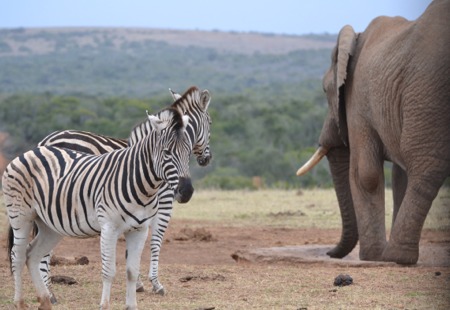
And the animals?
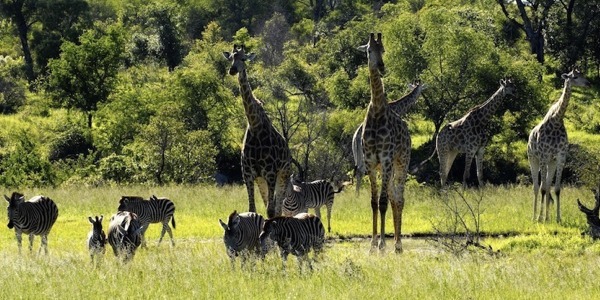
The animals alone are
reason to visit. One of the world's first wildlife
conservation areas was South Africa's Kruger Park, more
than a century old. Today it is just one part of a
single broad conservation area that spans private and
public game parks, and even stretches across national
borders into neighboring Mozambique and Zimbabwe. An
hour's drive from such urban jungles as Pretoria and
Johannesburg, you can see lions, elephants, buffalo and
hundreds more species in their natural environments.
South Africa is also a bird watcher's - paradise.
Will I see the big
five?
Maybe. Many reserves
have all the big five - lion, leopard, elephant, rhino
and buffalo - but it's not that easy to see them all,
particularly leopard. Leopards are nocturnal, secretive
and well camouflaged, but there are some reserves where
they are easily spotted. However, just being in the
bush, seeing tiny animals like ants and frogs and
learning the relationship between them, can be even more
exciting than a procession of lions and elephants. So,
even if you miss out on one or two of the big guys,
you'll still have a great time.
What is the difference between the National Parks and
the Private Reserves?
The national parks are administered by South African
National Parks which ensures a standardized level of
accommodation and facilities.
Park fees are kept to a
minimum to enable as many people as possible to enjoy
our wonderful natural heritage. The game watching in the
private parks is quite often of an equal standard to
that of the national parks, but the accommodation is
usually far more luxurious, and the service very
attentive. Of course, this level of luxury comes at a
price, but the private lodges are a good choice if you
would like to be pampered.
Where can I see game
in a malaria-free area?
The Eastern Cape, the
Western Cape, the Northern Cape, parts of the Northwest
Province and the Waterberg area of Limpopo province are
free of malaria. Of these, the best game viewing is Addo
in the Eastern Cape, the Kgalagadi Transfrontier Park in
the Northern Cape, Madikwe and Pilanesberg in the
Northwest, and Limpopo's Waterberg.
Can I visit a game
park on my own?
Yes, absolutely. South African National Parks have
designed all their parks to cater for the independent
traveler, so you can drive in, set up home in your
rented chalet, and drive yourself around. However, you
may get more out of your stay if you opt to do one or
two escorted drives.
Time Differences
South Africa operates two hours ahead of Greenwich Mean
Time throughout the year, making it an hour ahead of
Central European Winter Time, seven hours ahead of
Eastern Standard Winter Time and seven hours behind
Australian Central Time.
Getting there
Johannesburg International Airport is the major airport
in South Africa and is the hub for 45 airlines from all
five continents. Flights from Europe are generally
overnight and just a sleep away - an aperitif, dinner,
sound sleep, and a good breakfast - and voila, you're in
South Africa! The direct flights between the USA and
Johannesburg or Cape Town are about 15 hours, and
flights between London and Johannesburg take about 12
hours.
Passports and Visas
For the majority of foreign nationals who travel to
South Africa for vacation, entry is straightforward and
hassle-free. All visitors to South Africa must be in
possession of a valid passport in order to enter the
country, and in some cases, a visa.
Travelers from certain regions of the world
(Scandinavia, Japan, the USA, and most Western European
and Commonwealth countries) do not need to formally
apply for a visa. Upon arrival in South Africa,
countries falling into this category will automatically
be given a free entry permit sticker that
outlines how long they may remain in the country. This
automatic entry permit is usually for a maximum of 90
days, though the immigration officer may tailor the
time period according to the airline tickets held.
Foreign nationals from some other countries are offered
this service, but for a maximum of 30 days. If
visitors want to stay for a longer period, they will
have to apply formally for a visa, as opposed to relying
on the automatic entry permit.
For the majority of foreign nationals who travel to
South Africa for vacation, entry is straightforward and
hassle-free. All visitors to South Africa must be in
possession of a valid passport in order to enter the
country, and in some cases, a visa. However, it is
important to note that under South Africa's Immigration
Act of 2002 (Act. 13 of 2002) in force since 7 April
2003, (a) Immigration Act, 2002 the passport shall
contain at least ONE unused page when presenting the
passport for endorsements'. This requirement, reflects
the requirements of many of the world's top travel
destinations, in line with the majority of global
destinations' requirements and failure to have a clear
page can result in entry being refused.
To determine whether
you require a visa to enter South Africa, visit the
comprehensive South African Home Affairs Department
website at:
http://home-affairs.pwv.gov.za. For South African
missions abroad, visit
http://www.dfa.gov.za/foreign/sa_abroad/index.htm.
Banks and Money
The currency unit is the Rand, denoted by the symbol R,
with 100 cents making up R1 (one Rand). Foreign currency
can be exchanged at local banks and Bureau de Changes.
Most major international credit cards such as American
Express, Diners Club, MasterCard, Visa and their
affiliates are widely accepted.
Tipping
Most restaurants do not add a service charge to bills -
thus it is customary to leave a 10-15% tip. Parking and
petrol station attendants should be given whatever small
change you have available. This is always appreciated,
even though it may seem a small amount.
Tax
Value-added-tax (VAT) is charged on most items. Foreign
tourists to South Africa can have their 14% VAT refunded
provided that the value of the items purchased exceeds
R250.00. VAT is refunded at the point of departure
provided receipts are produced.
Disabled Travelers
Generally speaking, our facilities for disabled visitors
can be improved, and this is an area our government is
working on. An increasing number of accommodation
establishments have wheelchair ramps and bathroom
facilities for the disabled. Almost every national park
has at least one accessible chalet and many
accommodation establishments have one or two
wheelchair-friendly rooms. Most of our sports stadiums
have accessible suites, stands or areas for wheelchairs
near accessible parking as well as special toilet
facilities. Most public buildings also caters for
wheelchair access.
Clothing
The seasons in the Southern Hemisphere are directly
opposite to those of the Northern Hemisphere. For summer
months, lightweight (cottons and linens), short-sleeved
clothes are best, although a light jersey/jumper might
be needed for the cooler evenings. Umbrellas and
raincoats are essential for the summers and the Western
Cape winters. Warmer clothes are needed for the winter
months.
Electricity
South Africa's electricity supply: 220/230 volts AC 50
Hz
Exceptions: Pretoria (230 V) and Port Elizabeth (200/250
V)
Most plugs have three round pins but some plugs with two
smaller pins are also found on appliances. Adaptors can
be purchased but may be in short supply. US-made
appliances may need a transformer.
Health and Safety
Many foreigners are unaware that South Africa has a
well-developed infrastructure, high standards of water
treatment and medical facilities equal to the best in
the world. Here we address any health and safety
questions you may have.
Hospitals and
medical care
In a great many medical disciplines, South Africa is a
global leader. In fact, South African trained doctors
are sought after all over the world, so this should give
an indication of the standard of medical care available.
There is a large network of public and private hospitals
countrywide, offering excellent service. However,
clients must have adequate health insurance to cover the
fees private hospitals charge.
Malaria
Malaria is found only in the Lowveld of Mpumalanga and
Limpopo and on the Maputaland coast of KwaZulu-Natal.
Malaria is not much of a risk in the winter months.
Although the incidence of malaria is rare, it would be
best to take adequate precautions if you choose to visit
these areas.
Our government has
embarked on an extensive anti-malaria program (in
co-operation with Swaziland and Mozambique) and the
incidence of malaria is decreasing. One reassuring thing
about malaria is that there is absolutely no way at all
that you can contract it unless you are bitten by an
infected mosquito. And with modern insect repellents and
some common sense one can reduce the chances of being
bitten to close to zero.
The cheapest, safest
and most effective measures against malaria are physical
barriers such as a mosquito net, and the use of a good
insect repellent. If you decide to take malaria
prophylaxis, it is essential that they take the drugs
according to the directions on the package insert. You
will need to start a week or two before entering a
malaria-endemic area and should continue taking the
drugs for four weeks after leaving the malaria risk
area. It is advisable to consult a medical professional
before embarking on a course of malaria prophylaxis.
Note that expectant mothers should avoid malaria
medications.
Personal safety
For tourists, South Africa is as safe as any other
destination in the world. South Africa boasts a vast
array of cultures, communities, sites and attractions.
Most parts of the country can be safely visited by
tourists provided they take basic common-sense
precautions (for example not walking alone in deserted
areas at night and being circumspect about how much
photographic equipment or flashy jewelry you carry Most
of the crime that takes place in South Africa is between
people who know each other and random acts of violence
are the minority of cases. Most major cities run
organized crime prevention programmes Basic Safety Tip
guidelines will be available at hotels and tourism
information offices
If you are in doubt as
to the safety of a particular area or attraction,
contact the National Tourism information and Safety Line
on 083 123 2345. This number may also be used for
practical assistance in replacing lost documents or
reporting incidents.
Food and water
As a rule, tap water in South Africa is safe to drink as
it is treated and is free of harmful microorganisms. In
hotels, restaurants and nightspots, the standards of
hygiene and food preparation top-notch. It is safe to
eat fresh fruit and salads and to put as much ice as you
like in your drinks - a good thing, too, after a day on
the beach or in the bush.
Road safety
Our transport infrastructure is excellent and our roads
are in good condition. However, the distances between
towns are significant, so if you're planning to
self-drive, it is a good idea to plan your itinerary to
ensure they don't drive long distances as fatigue is a
major cause of road accidents. Avoid long car journeys
that necessitate driving at night as it always carries
more risk. Also, in some of the more remote rural areas,
the roads are not fenced so there may be stray animals
on the road - which could be very dangerous at night.
(Cows don't have headlights.)
We have very strict
drinking and driving laws - with a maximum allowable
alcohol blood content of 0.05%. Translated that means
about one glass of wine for the average woman and
perhaps 1.5 or two for the average or large man. Our
speed limits are 120kmph on the open road, 100kmph on
smaller roads and between 60 and 80kmph in towns. Be
aware that even major national roads cut through
residential areas so there may be a speed limit of 80 or
60kmph on a road that looks like an autobahn. This is to
protect pedestrians, especially children, so
we really do encourage people to comply.
Driving
Non-residents are permitted to drive with a driving
license issued and valid in their own country, provided
it bears the photograph and signature of the holder and
is in English. If your drivers license does not meet
these requirements, an international driver’s license is
required. Driving is on the left and the wearing of
seatbelts is compulsory.
Vaccinations
Visitors who are entering South Africa from a yellow
fever zone must have a valid international yellow fever
inoculation certificate. Only infants under the age of
one year are exempt. Immunization against cholera and
small pox are not required and no other vaccinations are
required when visiting South Africa.
Shopping
Most major shopping centers and malls operate 7 days
a week, but you will find that in the smaller towns and
rural areas that shops are closed on a Sunday.
Monday - Saturday:
09:00 to 17:00
Sunday: 09:00 - 14:00
Information on this page supplied by SA Tourism